John Sutton
|

|
John Sutton is the Sir John Hicks Professor of Economics at the London School
of Economics. He has been a
Visiting Associate Professor at Tokyo University, a Marvin Bower Fellow at the
Harvard Business School, and a Visiting Professor of Economics at Harvard
University, and at the Graduate School of Business, University of Chicago. His books include Sunk Costs and Market Structure (MIT
Press, 1981), Technology and Market Structure (MIT Press, 1998), Marshall's Tendencies: What Can Economists Know? (MIT and Leuven University
Press, 2000) and Competing in Capabilities: The Globalization Process (Oxford University Press, 2012). He has been a consultant for the World Bank since 2000, and served on the
Advisory Committee on Access to the Japanese Market (Tokyo) from 1995 to 2002.
He served as a member of the Group of Economic Advisors to the President of the
European Union from 2001-2004, and of the Enterprise Strategy Group (Ireland),
which reported in 2004. He is a Fellow of the Econometric Society, and of the
British Academy, and was President of the Royal Economic Society from 2004 to
2007.
|
THE ENTERPRISE MAP PROJECT
John Sutton's Enterprise Map Project aims at providing a detailed profile of industries and of leading industrial companies in each of several countries in sub-Saharan Africa. The first
four volumes on Ethiopia, Ghana, Tanzania and Zambia are now available:
You may download An Enterprise Map Of
Ethiopia (Sutton and Kellow), free of charge, in Adobe PDF format.
For the Chinese version please click here
Please click here for An Enterprise Map Of Ghana (Sutton and Kpentey) Click here for An Enterprise Map of Tanzania (Sutton and Olomi)
and here for An Enterprise Map of Zambia (Sutton and Langmead)
NEW RELEASE:
An Enterprise Map of Mozambique. For the portuguese version please click
here.
The Enterprise Map books are published by the International Growth Centre in association with the London Publishing Partnership. The hard copy version is available from Central Books ,see http://tinyurl.com/igc-ethiopia.
This project is supported by the International Growth Centre , which is directed from hubs at the London School of Economics and the University of Oxford. The IGC was initiated and is funded by the Department for International Development (DFID).
To see a video introducing the series click here
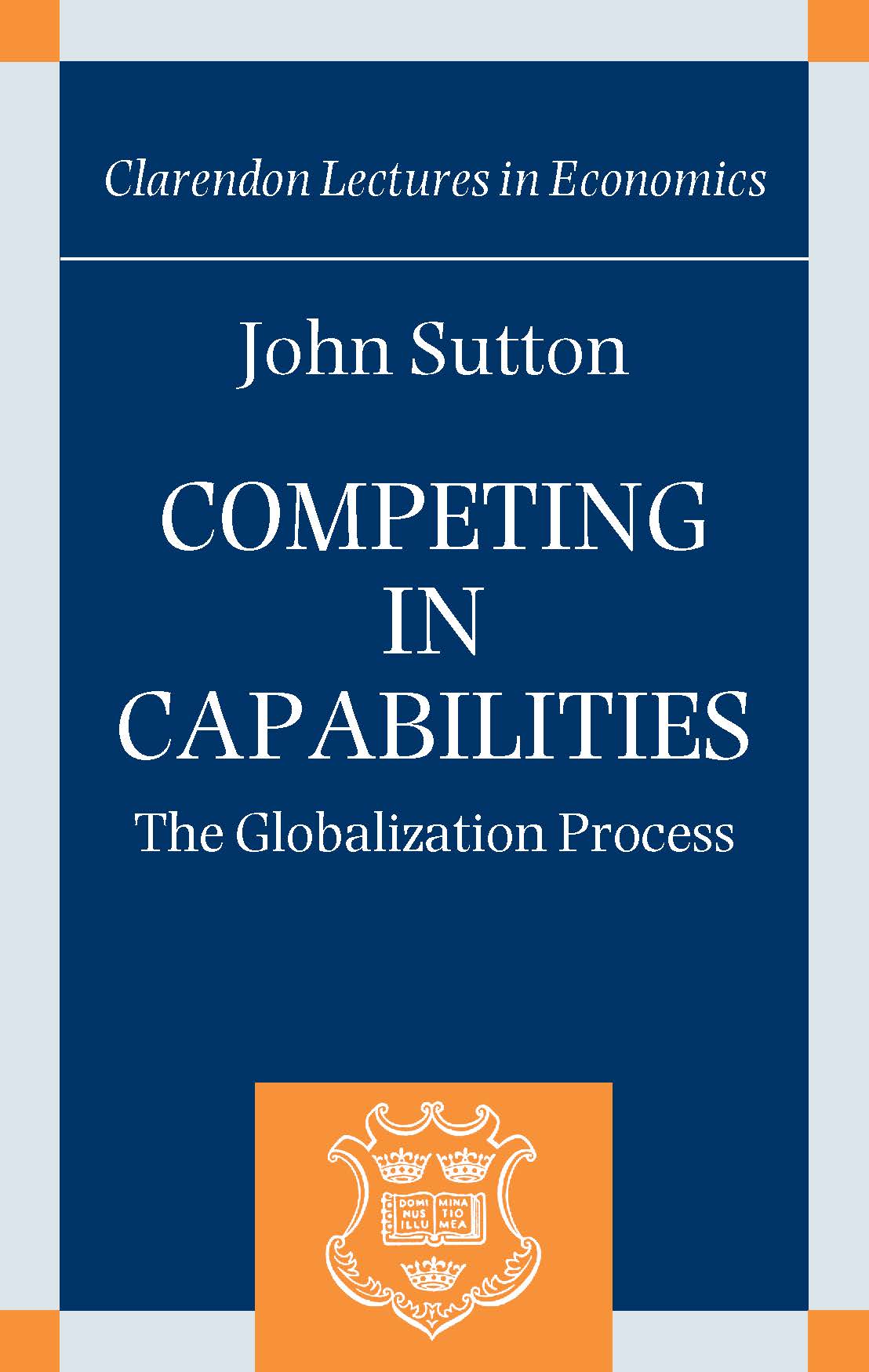
COMPETING IN CAPABILITIES
This book offers a new perspective on the economics of globalization, based on the concepts of firms’ capabilities as the immediate cause of countries’ wealth. It presents new ways of looking at the way China, India, and Africa have been drawn into the global economy over the past two decades. It offers new perspectives on some of the most central questions in the current debate: What effects does the rise of China have for the advanced industrial economies? Why have some industries adapted quickly and effectively to the changing global scene, while others have not? How were the ‘Transition Economies’ of Eastern Europe affected by trade liberalization? How have the economic prospects of sub-Saharan African countries changed over the past decade? This analysis contributes to the recent literature on quality and trade, which is providing a new and different approach to the analysis of globalization, and which focuses on those economic mechanisms that are central to the current wave of this centuries-old phenomenon.
To read a sample of this book click here
|


|
Contact
Information - CV - Recent
Papers - Links
Contact Information
Phone: +44 (0) 20 7955 7716
Fax: +44 (0) 20 7955 6951
Email: j.sutton@lse.ac.uk
Address:
Department of Economics
London School of Economics and Political Science
Houghton Street
London
WC2A 2AE
Support Staff
Gisela Lafico, STICERD
Phone: +44 (0) 20 7955 6674
Email: g.lafico@lse.ac.uk
^
Selected Publications
'Industrial
Organization', in China's Great Economic Transformation, Loren Brandt
and Tom Rawski (eds.), Cambridge University Press, 2008.
Quality, Trade and the “Moving
Window”: the Globalization Process
This paper analyses the globalization process by reference to a model in which
firms and countries differ both in productivity and quality. The model
implies that there is a lower bound to quality below which firms cannot sell,
however low the (local) wage rate they face. The range of quality levels
between the maximum level and this lower bound shifts upwards when trade is
liberalized (the 'moving window'). The initial ('impact') effect of
globalization, i.e., that associated with trade liberalization, in an initially
segmented (but not autarkic) world economy may well reduce welfare in countries
with intermediate levels of capability , but these countries stand to be the
most important gainers as capabilities are transferred across countries in
subsequent phases of the globalization process.
Market Share Dynamics and the 'Persistence of Leadership'
Debate
This paper sets out an analytical framework which can be used to examine the
evolution of market shares and to address debates regarding the "persistence of
dominance" question. The method is applied to a study of 45 Japanese
manufacturing industries over a 25-year period. (Now published, American
Economic Review, March 2007 and the published version can be accessed via
http://dx.doi.org/10.1257/aer.97.1.222).
Market Structure - Theory and Evidence
This paper surveys the recent literature on the determinants of Market
Structure, with particular reference to the Bounds approach. It appears in Volume 3 of the Handbook of Industrial
Organisation, edited by Robert Porter and Mark Armstrong.
The Auto-Component Supply Chain in China and India: a
benchmarking study
This report offers an assessment of the current state of the auto-component
supply chain in China and India. It is based on a large-scale programme of
plant studies, in both countries.
The Indian Machine-Tool Industry
A Benchmarking Study
This report sets out some benchmarking results on productivity and quality for
CNC (computer numerically controlled) machine tools produced by leading Indian
manufacturers. The study was carried out by Professor J. Sutton of the London
School of Economics, with the assistance of Mr. G. Doshi, on behalf of the World
Bank, during the period December 1999 to August 2000.
^
Links
^
This page was last updated on
18/03/2015
Copyright © London School of Economics and Political Science, 2010
|


